

A Systematic Transfer Plan, commonly known as STP, is a mutual fund facility that allows investors to move money from one scheme to another in a planned and gradual manner. Instead of investing a large amount in one go, the investor transfers money at regular intervals from a source scheme to a target scheme. This makes STP a practical option for
investors who want structure, discipline, and better control over how their money enters the market.
In simple terms, STP helps you shift your money from one fund to another without making a sudden move. It is often used when an investor has a lump sum amount but does not want to put the entire amount into equity at one time. By transferring the money slowly over
weeks or months, STP reduces the pressure of market timing and supports a more measured investment approach.
What Is STP in Mutual Funds?
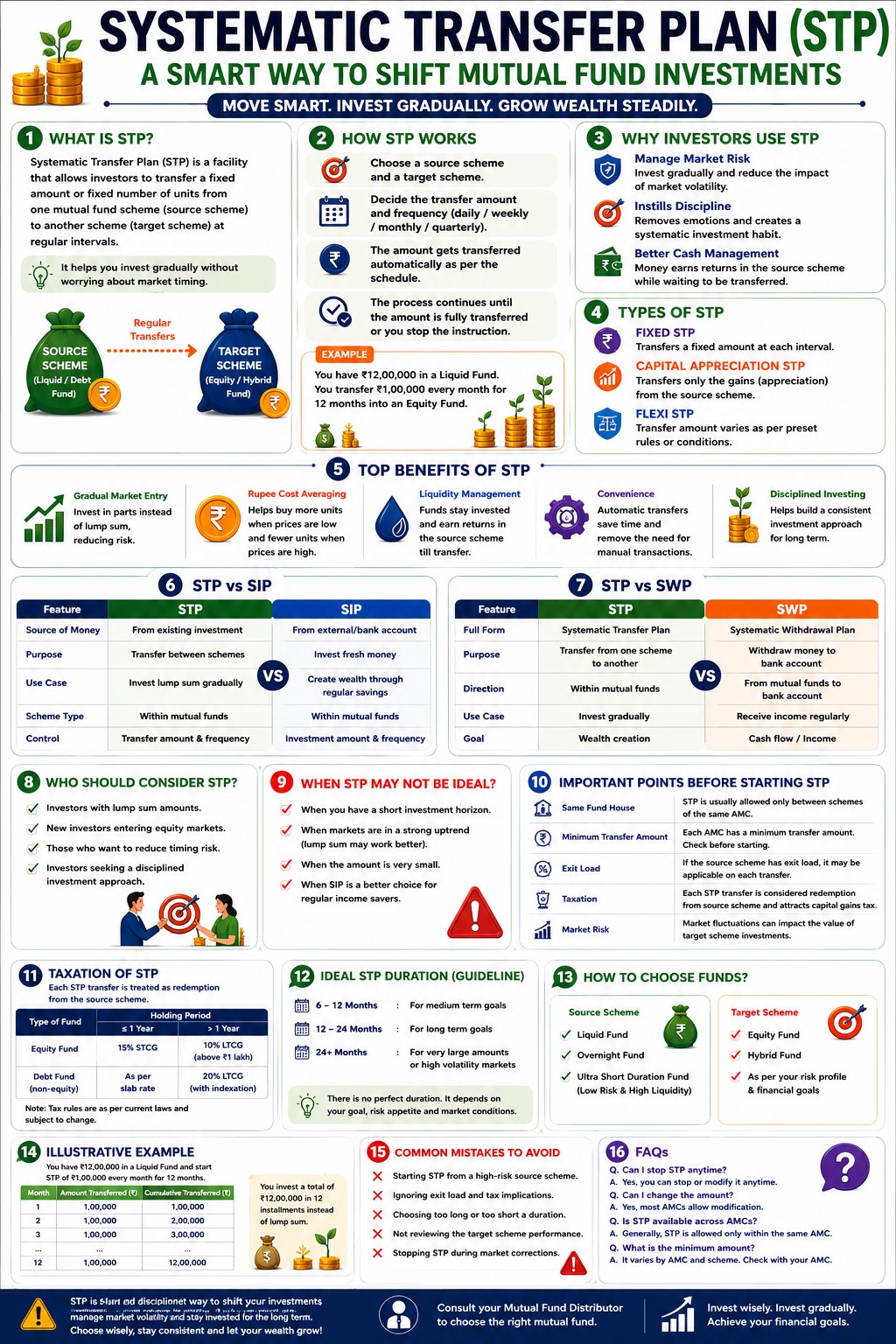
STP stands for Systematic Transfer Plan. It is a mutual fund strategy in which a fixed amount or fixed number of units is moved from one scheme to another at regular intervals. Usually, the transfer happens within the same fund house. The source scheme is typically a debt fund, liquid fund, or other conservative scheme, while the target scheme is often an equity or hybrid fund.
This method is useful because it allows investors to keep their money productively invested while they wait to enter a more volatile asset class. For example, instead of holding a large amount in a savings account, an investor can place it in a liquid fund and then transfer small portions into an equity fund over time.
STP is especially useful in uncertain markets. Many investors feel nervous about entering equity markets with a large lump sum because prices may move sharply after the
investment. STP helps reduce that concern by spreading the investment over multiple dates.
How STP Works
The working of STP is simple and systematic. First, the investor chooses a source scheme and a target scheme. Then the investor decides how much money should be transferred and how frequently the transfer should happen. The transfer may be monthly, weekly, or quarterly, depending on the options provided by the fund house.
Once the plan is set, the money begins moving automatically according to the selected schedule. This means the investor does not need to manually place each transfer. The process continues until the planned amount is fully transferred or the investor stops the instruction.
A common example is an investor who receives a lump sum bonus or sale proceeds and wants to invest in equity for the long term. Instead of investing the entire amount in one day, the investor can first place the money in a liquid fund and then move a fixed amount every month into an equity fund. This way, the money enters the market in stages rather than all at once.
Why Investors Use STP
One of the main reasons investors use STP is to manage market risk better. Equity markets can be volatile, and investing a large sum on a single date may feel risky. By spreading the investment over time, STP reduces the emotional stress associated with timing the market.
Another reason is discipline. Many investors intend to invest later but delay action due to confusion, fear, or indecision. STP creates a structured process that removes repeated decision-making. Once the transfer is set up, the plan continues automatically.
STP is also useful for cash management. Money parked in a source scheme can continue earning returns while it waits to be transferred. This is more efficient than keeping the amount idle. For investors with a clear long-term goal, this can be a very practical way to manage a lump sum.
Main Types of STP
There are different types of STP, and the exact structure may vary from one mutual fund house to another. However, the most common forms are fixed STP, capital appreciation STP, and flexi STP.
A fixed STP transfers the same amount at each interval. This is the simplest and most commonly used version. For example, if an investor chooses to transfer Rs 10,000 every month, the same amount will move from the source scheme to the target scheme each month.
A capital appreciation STP transfers only the gains earned in the source scheme. In this case, the original capital remains in the source fund, and only the appreciation is shifted. This
option is useful for investors who want to preserve the base amount while gradually moving profits into the target scheme.
A flexi STP allows the transfer amount to vary based on certain conditions or preset rules. This can be helpful for investors who want more flexibility in how much is transferred at each stage. The availability of these options depends on the mutual fund scheme and fund house rules.
Benefits of STP
STP offers several important benefits for mutual fund investors. One of the biggest advantages is that it reduces the pressure of timing the market. Rather than entering at a
single point, the investor enters in stages, which can make the process feel more controlled.
It can also support better liquidity management. Since the source money stays invested before transfer, it may generate some return instead of sitting unused. This makes STP more efficient than leaving money idle in cash.
Another benefit is convenience. Once the STP is set up, the transfers happen automatically. This saves time and helps investors stay consistent with their financial plan. For people who prefer a systematic and disciplined approach, STP can be a very effective tool.
STP may also help investors move gradually into equity without overwhelming themselves. This is especially useful for first-time equity investors or people who are cautious about volatility. By entering in parts, they may feel more comfortable with the overall investment journey.
STP vs SIP
STP and SIP are often mentioned together, but they are not the same. A SIP, or Systematic Investment Plan, is used to invest money regularly from a bank account into a mutual fund. STP, on the other hand, transfers money from one mutual fund scheme to another.
The main difference lies in the source of the money. SIP brings in fresh money, usually from income. STP shifts existing money already invested in one scheme. So if an investor has a monthly salary, SIP is often the natural choice. If the investor already has a lump sum amount, STP may be more suitable.
Both tools support disciplined investing, but they serve different purposes. SIP is for building wealth from regular income, while STP is for gradually moving money between schemes in a planned way.
STP vs SWP
STP is also different from SWP, or Systematic Withdrawal Plan. In SWP, money is withdrawn from a mutual fund and sent to the investor’s bank account at regular intervals. In STP, the money stays inside the mutual fund system and moves from one scheme to another.
This difference is important because the goals are different. STP is used for transferring money within mutual funds, while SWP is used for generating regular cash flow from an investment. A retiree looking for monthly income may prefer SWP, while an investor shifting from debt to equity may prefer STP.
A simple way to remember it is this: SIP means investing, STP means shifting, and SWP means withdrawing. Each one serves a different purpose in financial planning.
Who Should Consider STP?
STP is suitable for investors who have received a lump sum amount and do not want to invest it all at once. It can also be useful for those who want to move from a conservative fund to a more growth-oriented fund in a phased way.
It may be particularly helpful for people who are cautious about market volatility. If
someone is uncomfortable with the idea of entering equity markets on a single day, STP
offers a more gradual route. It also suits investors who like to follow a structured plan rather than making frequent manual decisions.
However, STP is not a universal solution. Whether it is suitable depends on the investor’s goals, time horizon, risk tolerance, and cash flow needs. It works best when used as part of a broader financial plan.
Important Things to Check Before Starting STP
Before starting an STP, the investor should check whether the source and target schemes belong to the same mutual fund house. STPs generally work within the same fund family, so this is an important practical point.
It is also important to check the minimum transfer amount, frequency options, and any exit load or tax implications. These details may affect the suitability of the plan and should be reviewed carefully before setting it up.
Investors should remember that STP does not eliminate risk. It only changes the way money enters the market. The target scheme can still rise or fall depending on market conditions, and the final outcome depends on how the chosen funds perform over time.
Conclusion
A Systematic Transfer Plan is a thoughtful and disciplined way to move money between mutual fund schemes. It is especially useful for investors with a lump sum amount who want a gradual entry into equity or another target asset class. By spreading the transfer over time,
STP can reduce timing pressure, improve discipline, and make investing feel more manageable.
For many investors, STP acts as a bridge between holding cash and fully entering the market. It allows money to stay invested while waiting for transfer, and it helps create a step-by-step approach to wealth building. Used wisely, it can be a simple but effective part of long-term financial planning.


