
Why Everyone Should Have an Emergency Fund:
Imagine waking up one morning to find that your car has broken down, a family member needs urgent medical treatment, or your company announces unexpected layoffs. Such situations are stressful enough on their own—but they become even more challenging when you're not financially prepared.
This is where an Emergency Fund becomes your greatest financial ally.
Many people focus on investing, buying insurance, or planning for retirement, but often overlook the importance of building an emergency fund. Yet, it is one of the first and most essential steps in any financial plan.
In simple words, an emergency fund is not an investment—it's financial protection.
Let's explore why every individual and family should have one.
What is an Emergency Fund?
An emergency fund is a dedicated pool of money kept aside exclusively to meet unexpected financial needs.
It is meant for situations such as:
- Medical emergencies
- Job loss or salary delays
- Major vehicle repairs
- Urgent home maintenance
- Family emergencies
- Business cash-flow issues
- Unexpected travel due to emergencies
The key purpose of an emergency fund is to ensure that unforeseen events do not derail your financial stability.
Why is an Emergency Fund So Important?
1. It Protects You During Financial Emergencies
Life is uncertain. Emergencies don't come with prior notice.
Without an emergency fund, even a small financial shock can create significant stress. You may be forced to borrow money, swipe your credit card, or sell investments at an unfavorable time.
An emergency fund gives you the confidence to handle life's surprises without disrupting your long-term financial goals.
2. It Helps You Avoid Debt
Many people rely on personal loans or credit cards during emergencies.
While borrowing may solve an immediate problem, it often creates a bigger one—high-interest debt.
Imagine needing ₹1,00,000 for an emergency.
Using a credit card or personal loan could result in paying substantial interest over time, making recovery more difficult.
An emergency fund allows you to use your own money instead of borrowing, helping you stay debt-free.
3. It Protects Your Investments
Suppose you've invested in mutual funds, stocks, or fixed deposits for long-term goals.
If an emergency arises and you don't have liquid cash, you may have to redeem those investments prematurely.
This could mean:
- Missing future growth
- Paying exit loads or penalties
- Selling during market downturns
- Interrupting your financial goals
An emergency fund acts as a buffer, allowing your long-term investments to remain untouched.
4. It Reduces Financial Stress
Financial uncertainty is one of the biggest causes of stress for individuals and families.
Knowing that you have sufficient money available for emergencies provides peace of mind.
Instead of worrying about "What if something goes wrong?", you can focus on solving the problem itself.
Financial security often leads to better emotional well-being.
5. It Provides Job Security During Career Changes
Today's employment environment is constantly evolving.
Job losses, salary cuts, business slowdowns, or career transitions are becoming increasingly common.
If you have an emergency fund covering six to twelve months of expenses, you gain valuable time to:
- Search for the right job
- Upgrade your skills
- Start a business
- Make career decisions without panic
This financial cushion prevents desperate decisions driven by immediate cash needs.
6. It Supports Self-Employed Professionals
Business owners, freelancers, consultants, and self-employed individuals often experience irregular income.
Some months may be highly profitable, while others may generate very little income.
For such individuals, an emergency fund is even more critical because it ensures that regular household expenses continue to be met during periods of lower income.
7. It Helps During Medical Emergencies
Even with health insurance, medical emergencies can involve expenses that are not fully covered.
These may include:
- Deductibles or co-payments
- Medicines not covered by insurance
- Travel expenses
- Home care after hospitalization
- Temporary loss of income
An emergency fund bridges these financial gaps without causing additional stress.
8. It Gives You Financial Independence
One of the greatest benefits of an emergency fund is independence.
Without savings, you may need to depend on:
- Friends
- Family members
- Employers
- Banks
- Money lenders
Having your own emergency reserve means you stay financially self-reliant during difficult times.
9. It Helps You Handle Unexpected Expenses Calmly
Not every emergency is dramatic.
Sometimes life throws small but unavoidable expenses such as:
- Laptop repairs
- Mobile replacement
- Appliance breakdown
- School fee deadlines
- Plumbing or electrical repairs
Having emergency savings allows you to deal with these expenses without disrupting your monthly budget.
10. It Creates Financial Discipline
Building an emergency fund encourages consistent saving habits.
Instead of spending every rupee you earn, you begin prioritizing financial security.
Over time, this discipline positively influences other financial goals such as investing, retirement planning, and wealth creation.
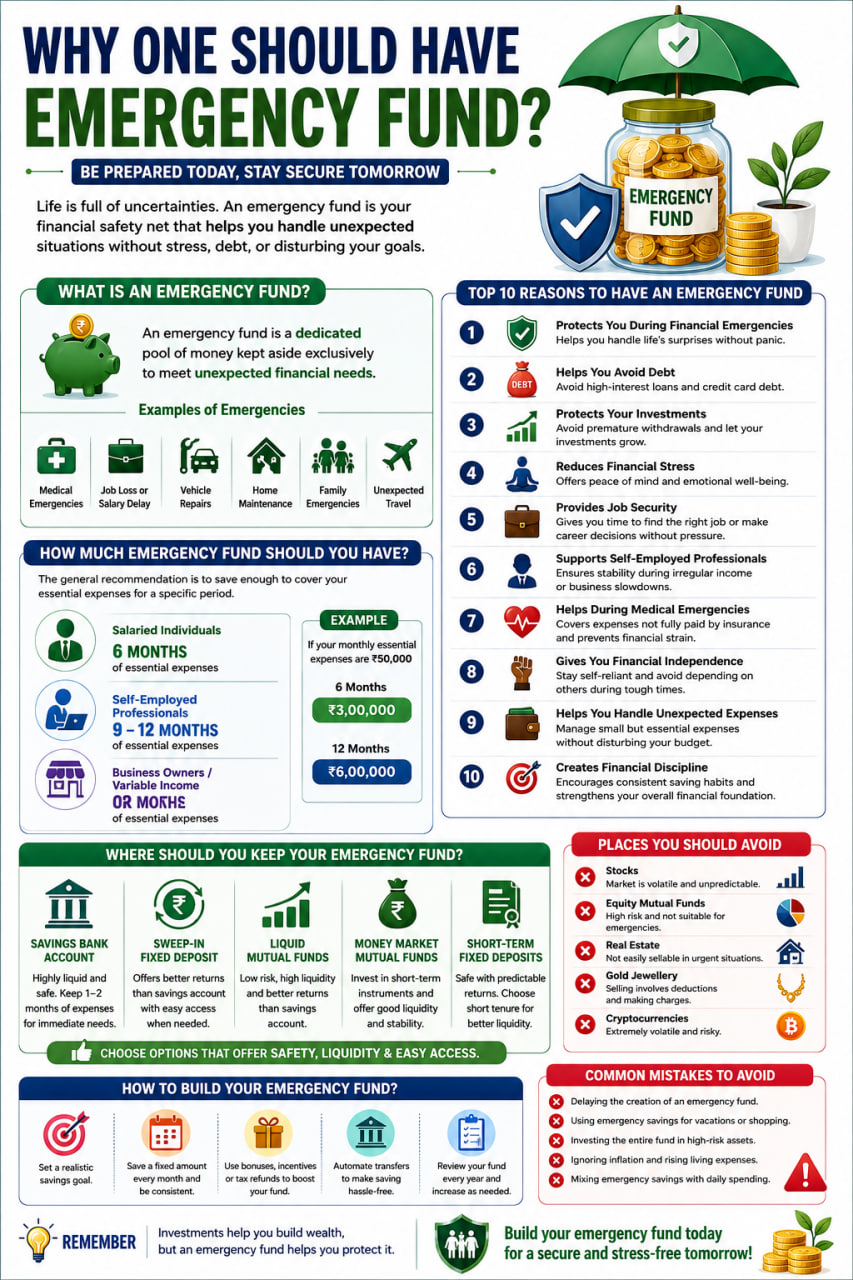
How Much Emergency Fund Should You Have?
Financial experts generally recommend maintaining:
- Salaried Individuals: 6 months of essential household expenses
- Self-employed Professionals: 9–12 months of expenses
- Business Owners or Individuals with Variable Income: 12 months or more, depending on income stability
For example:
If your monthly essential expenses are ₹50,000:
- 6 months = ₹3,00,000
- 12 months = ₹6,00,000
The right amount depends on your lifestyle, family responsibilities, and income stability.
Where Should You Keep Your Emergency Fund?
Your emergency fund should prioritize:
- Safety
- Liquidity
- Easy accessibility
Suitable options include:
- Savings Bank Account
- Sweep-in Fixed Deposit
- Liquid Mutual Funds (for a portion of the fund)
- Money Market Mutual Funds
- Short-term Fixed Deposits
Avoid keeping your emergency fund entirely in:
- Stocks
- Equity Mutual Funds
- Real Estate
- Gold Jewellery
- Cryptocurrencies
These assets may not be easily accessible or could lose value when you need the money most.
How to Build an Emergency Fund
Building an emergency fund is easier when done systematically.
Here are a few practical steps:
- Start by setting a realistic savings goal.
- Save a fixed amount every month through automatic transfers.
- Use bonuses, incentives, or tax refunds to boost your fund.
- Keep the emergency fund separate from your regular spending account.
- Review and increase the fund annually as your expenses grow.
Remember, consistency matters more than the amount you start with.
Common Mistakes to Avoid
- Delaying the creation of an emergency fund.
- Using emergency savings for vacations or shopping.
- Investing the entire emergency fund in high-risk assets.
- Ignoring inflation and rising living expenses.
- Mixing emergency savings with daily spending money.
Treat your emergency fund as a financial safety net, not a spending account.
Final Thoughts
An emergency fund is the foundation of a strong financial plan. Before investing for wealth creation or planning for retirement, it is essential to build a reserve that can protect you from life's unexpected challenges.
It safeguards your investments, helps you avoid debt, reduces financial stress, and gives you the confidence to face uncertainties without compromising your long-term goals.
Whether you are a salaried employee, a business owner, a freelancer, or a young professional just starting your financial journey, an emergency fund is not a luxury—it is a necessity.
Remember:
"Investments help you build wealth, but an emergency fund helps you protect it."
Start today, even if it's with a small amount. Every contribution brings you one step closer to greater financial security and peace of mind.


