

Financial Lessons from Indian Freedom Fighters: Timeless Principles for Building Wealth
India's freedom struggle was not only a battle for political independence but also a movement built on discipline, sacrifice, self-reliance, and long-term vision. The great freedom fighters who shaped our nation left behind lessons that extend far beyond history. Their values can inspire us to make wiser financial decisions in today's fast-changing world.
While they may not have spoken about mutual funds, SIPs, insurance, or retirement planning, their principles closely align with the foundations of sound financial management. Let's explore the timeless financial lessons we can learn from some of India's greatest freedom fighters.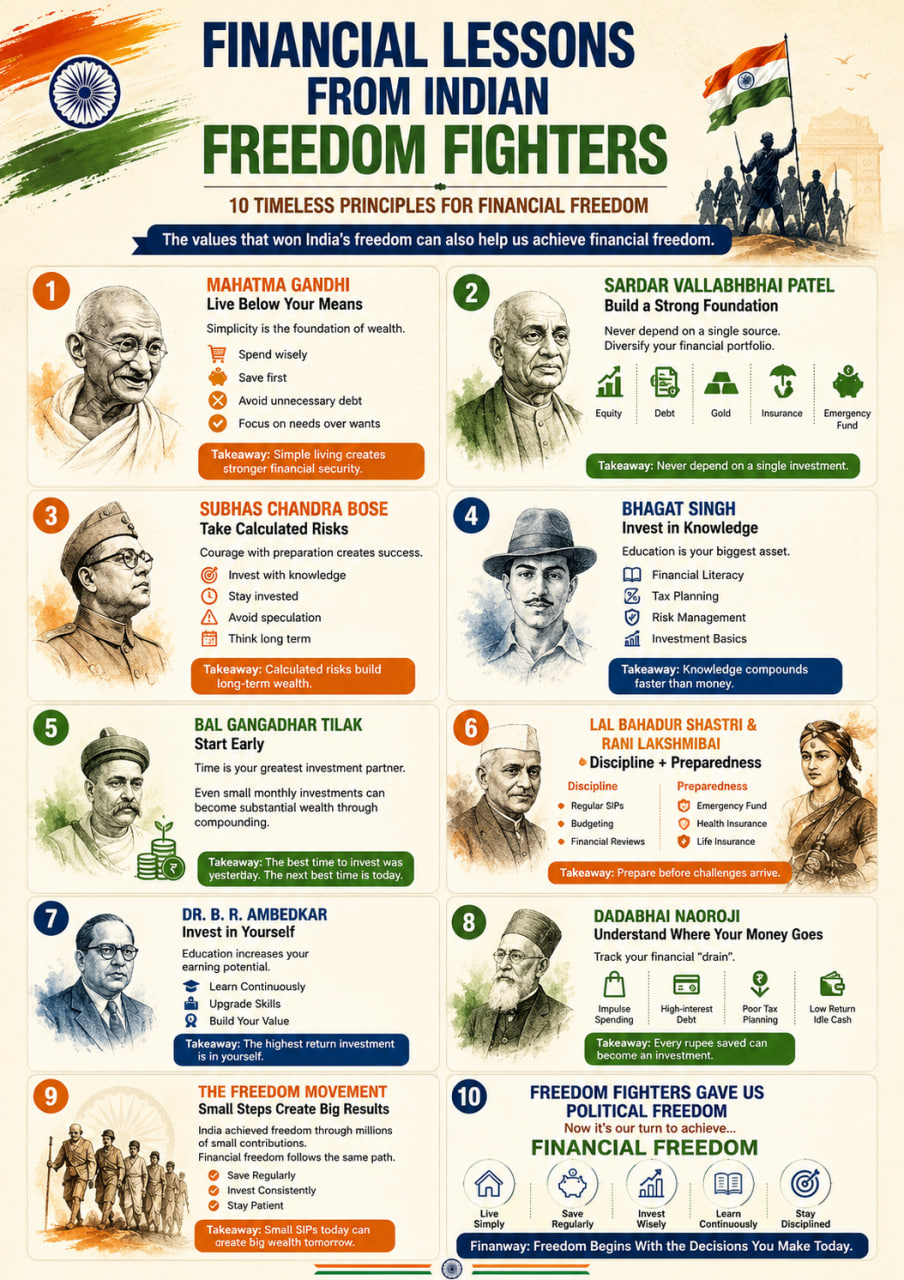
1. Mahatma Gandhi – Live Below Your Means
Mahatma Gandhi believed in simplicity. His lifestyle reflected minimalism, self-control, and mindful consumption. He proved that true wealth lies not in possessions but in purpose.
Financial Lesson:
One of the biggest reasons people struggle financially is lifestyle inflation. As income increases, expenses often rise even faster. Gandhi's philosophy teaches us to distinguish between needs and wants.
Spend thoughtfully, avoid unnecessary debt, and focus on saving before spending. A simple lifestyle creates room for investments, emergency funds, and financial independence.
Modern Application:
- Follow a monthly budget.
- Save first, spend later.
- Avoid impulse purchases.
- Build wealth through disciplined investing.
2. Sardar Vallabhbhai Patel – Diversify and Build Strong Foundations
Known as the "Iron Man of India," Sardar Patel united more than 560 princely states into one nation. His strength lay in bringing diverse elements together under a common vision.
Financial Lesson:
Never depend on a single source of income or investment. Diversification reduces risk and creates stability.
A balanced financial portfolio may include:
- Equity investments
- Debt instruments
- Gold
- Emergency savings
- Insurance
- Retirement planning
Just as Patel built a united India on a strong foundation, every individual should build a diversified financial future.
3. Subhas Chandra Bose – Take Calculated Risks
Netaji Subhas Chandra Bose demonstrated extraordinary courage. He challenged conventional paths and took bold decisions after careful planning and preparation.
Financial Lesson:
Wealth creation requires taking calculated risks—not reckless ones.
Avoid keeping all your money idle in savings accounts because inflation silently reduces purchasing power. At the same time, avoid speculative investments based solely on rumors or market hype.
Evaluate risks, understand your investment horizon, and make informed decisions.
Modern Application:
- Invest according to your risk profile.
- Stay invested for the long term.
- Avoid emotional investing.
4. Bhagat Singh – Invest in Knowledge
Bhagat Singh was one of the most well-read revolutionaries of his time. Even during imprisonment, he spent countless hours reading books on economics, politics, philosophy, and history.
Financial Lesson:
The best investment often begins with education.
Before investing money, invest in knowledge. Understand financial products, taxation, inflation, risk, and asset allocation.
Financial literacy helps avoid fraud, poor decisions, and unrealistic expectations.
Remember:
Knowledge compounds just like investments.
5. Bal Gangadhar Tilak – Start Early
Bal Gangadhar Tilak ignited the spirit of freedom decades before independence. His early efforts inspired generations of Indians.
Financial Lesson:
The earlier you start investing, the more powerful the effect of compounding becomes.
Even modest monthly investments can grow into significant wealth over long periods.
Time is often more valuable than the amount invested.
A person investing ₹5,000 per month for 30 years generally builds far greater wealth than someone investing a larger amount but starting much later.
Start today—even if the amount is small.
6. Lal Bahadur Shastri – Discipline Creates Strength
Shastri Ji's life reflected honesty, discipline, and personal responsibility. His famous slogan, "Jai Jawan, Jai Kisan," encouraged commitment and consistency.
Financial Lesson:
Financial success is rarely achieved through shortcuts.
Consistency matters more than occasional large investments.
Whether it's:
- Monthly SIPs
- Regular savings
- Annual financial reviews
- Insurance premium payments
Discipline creates long-term financial stability.
7. Rani Lakshmibai – Be Prepared for Uncertainty
The Queen of Jhansi displayed exceptional courage during one of the most uncertain periods in Indian history. She was always prepared to face unexpected challenges.
Financial Lesson:
Life is unpredictable.
Medical emergencies, job loss, business setbacks, or economic downturns can occur without warning.
Financial preparedness includes:
- Emergency fund covering 6–12 months of expenses
- Adequate health insurance
- Life insurance for earning members
- Proper nomination and estate planning
Preparedness reduces financial stress during difficult times.
8. Dr. B. R. Ambedkar – Empower Yourself Through Education
Dr. Ambedkar believed education was the strongest tool for empowerment. His lifelong commitment to learning transformed not only his own life but also the future of millions.
Financial Lesson:
Your earning potential grows with continuous learning.
Invest in:
- Professional development
- New certifications
- Skill enhancement
- Digital knowledge
- Financial education
The highest-return investment is often the one you make in yourself.
9. Dadabhai Naoroji – Understand Where Your Money Goes
Dadabhai Naoroji introduced the famous "Drain Theory," explaining how India's wealth was flowing out during British rule.
Financial Lesson:
Track your own financial "drain."
Many people unknowingly lose money through:
- High-interest debt
- Unnecessary subscriptions
- Frequent impulse spending
- Poor tax planning
- Low-return idle cash
Regularly reviewing expenses helps identify financial leakages and redirect money toward wealth creation.
10. The Freedom Movement – Small Contributions Create Big Change
India's independence was not achieved by one individual. It was the collective effort of millions contributing in their own ways over many years.
Financial Lesson:
Wealth creation also happens through small, consistent contributions.
Every monthly investment, every disciplined saving habit, and every informed financial decision moves you closer to financial freedom.
Never underestimate the power of consistency.
Small SIPs today can become significant wealth tomorrow.
Conclusion
The ideals of India's freedom fighters continue to inspire us—not only as citizens but also as responsible financial decision-makers.
Their lives teach us that success is built on discipline, patience, courage, knowledge, planning, and perseverance. These same principles form the foundation of financial well-being.
Political freedom gave us the opportunity to shape our future. Financial freedom is the responsibility each of us must now embrace.
As we remember the sacrifices of our freedom fighters, let us also commit to building financially secure families, making informed decisions, and creating a future where money becomes a tool for opportunity rather than a source of stress.
Because true independence is not just about living in a free nation—it is also about living with financial confidence, security, and dignity.


